Category: Resume Writing FAQ
Resume Bullet Points: Should You Focus on What You Did or Results You Achieved?
Here’s a question that separates average resumes from exceptional ones: Should your bullet points describe what you did, or should they focus on what happened because of what you did?
The answer is clear: Always focus on results and outcomes, not just tasks and responsibilities. This single shift in perspective is one of the most impactful changes you can make to your resume, often doubling or even tripling callback rates.
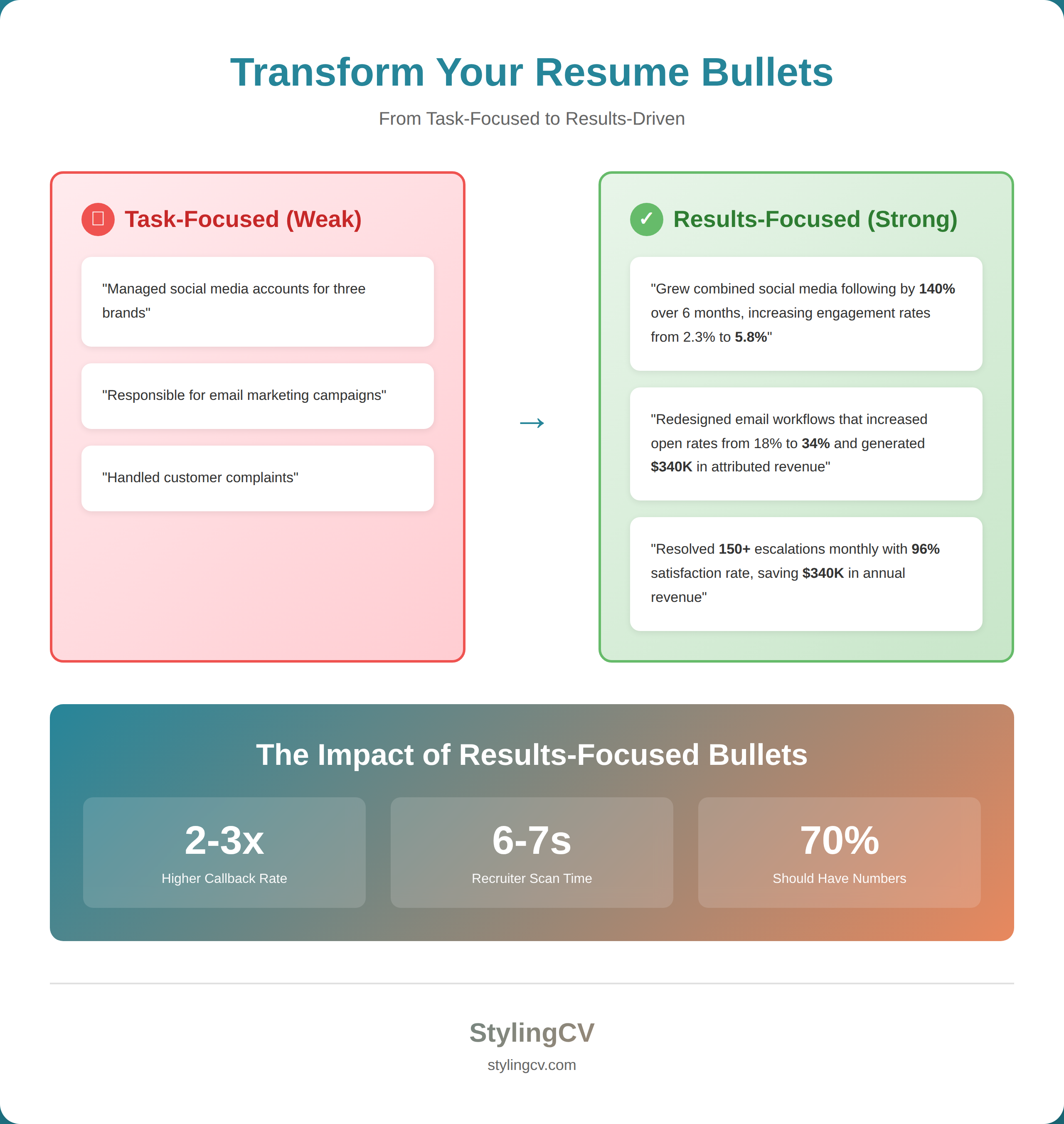
The answer is clear: Always focus on results and outcomes, not just tasks and responsibilities. This single shift in perspective is one of the most impactful changes you can make to your resume, often doubling or even tripling callback rates.
In this comprehensive guide, you’ll learn exactly how to transform task-focused bullets into results-driven achievements that grab recruiters’ attention and prove your value. We’ll cover the why, the how, and provide dozens of before-and-after examples across different industries.
Why Results Matter More Than Tasks
Consider these two bullet points for the same role:
| Task-Focused (Weak) | Results-Focused (Strong) | Impact |
|---|---|---|
| “Managed social media accounts for three brands” | “Grew combined social media following by 140% over 6 months by shifting posting schedule based on analytics, increasing engagement rates from 2.3% to 5.8%” | Numbers prove measurable value |
| “Handled customer service calls” | “Responded to 100+ daily customer inquiries with 94% first-call resolution rate, contributing to 15% reduction in support costs” | Quantifies volume and efficiency |
| “Created marketing materials” | “Developed content marketing strategy and 50+ assets that generated 85K monthly visitors and $2.4M in qualified pipeline” | Shows business impact |
Version A is just a job description—it tells employers you showed up. Thousands of candidates “manage social media accounts.” Version B demonstrates that you thought critically about your work, took data-driven action, and achieved measurable results. It answers the crucial question: “So what? Why should we hire you?”
The 6-Second Rule
Research consistently shows that recruiters spend an average of 6-7 seconds on an initial resume scan. In those precious seconds, they’re looking for standout achievements—numbers, results, and impact that jump off the page.
Resumes filled with task descriptions blend together into a sea of sameness. Resumes with quantified results and clear outcomes immediately stand out as belonging to high performers who deliver value.
The Fundamental Difference: Tasks vs. Results
Let’s clearly define the distinction:
Task-Focused Bullets (What You Did)
These describe your responsibilities, activities, or job duties. They answer “What did you do day-to-day?”
- “Managed a team of 8 employees”
- “Responsible for monthly reports”
- “Attended client meetings”
- “Handled customer service inquiries”
- “Created marketing materials”
Problem: These could describe anyone in that role. They don’t differentiate you or demonstrate value.
Results-Focused Bullets (What Happened Because of What You Did)
These describe outcomes, impact, achievements, and measurable changes. They answer “What improved, changed, or happened because you did your job well?”
- “Led team of 8 customer service representatives to achieve 94% satisfaction rating (up from 78%), reducing complaint escalations by 35%”
- “Developed automated monthly reporting dashboard that reduced manual reporting time from 12 hours to 45 minutes, improving data accuracy by 99%”
- “Conducted 40+ client presentations that closed $3.2M in new business, exceeding sales targets by 127%”
- “Resolved 150+ customer inquiries daily with 96% first-call resolution rate, contributing to 15% reduction in support costs”
- “Created content marketing strategy and 50+ assets that generated 85K monthly visitors and $2.4M in qualified pipeline”
Why these work: They’re specific, quantified, and demonstrate clear value. They prove you’re not just a task-completer, but someone who drives meaningful outcomes.
The Results-Driven Bullet Point Formula
Use this proven formula to transform any task into a results-focused achievement:
[Action Verb] + [What you did] + [How you did it] + [Quantified result/impact]Let’s break down each component:
1. Strong Action Verb
Start with a powerful, specific verb that conveys leadership and initiative. Avoid weak, passive verbs.
| Category | Strong Action Verbs | Weak Verbs to Avoid |
|---|---|---|
| Leadership | Led, Directed, Managed, Spearheaded, Orchestrated, Championed, Drove | Helped, Assisted, Participated, Involved, Responsible for, Worked on |
| Creation | Developed, Built, Designed, Created, Established, Launched, Implemented | |
| Improvement | Increased, Improved, Enhanced, Optimized, Streamlined, Accelerated, Strengthened | |
| Achievement | Achieved, Exceeded, Delivered, Generated, Secured, Won, Earned | |
| Problem-solving | Resolved, Identified, Analyzed, Diagnosed, Troubleshot, Eliminated | |
| Communication | Presented, Negotiated, Collaborated, Facilitated, Advocated, Persuaded |
2. What You Did
Describe the specific action or project clearly and concisely.
3. How You Did It (Optional but Recommended)
Include the method, strategy, or approach when it adds value and context.
4. Quantified Result/Impact
This is the most critical element. Include numbers, percentages, timeframes, or other measurable outcomes.
Full example:
"Implemented" [action verb] + "automated customer onboarding workflow" [what] + "using Zapier and HubSpot integration" [how] + "reducing onboarding time from 5 days to 8 hours (84% faster) and improving customer activation rate from 45% to 67%" [quantified results]Key Metrics That Prove Resume Impact
Understanding what types of metrics resonate with hiring managers helps you identify the right numbers to include in your bullets. Here are the most powerful categories:
| Metric Type | What to Measure | Example | Why It Matters |
|---|---|---|---|
| Revenue Impact | Sales, revenue growth, pipeline generated | “Generated $2.4M in qualified pipeline” | Direct bottom-line contribution |
| Efficiency Gains | Time saved, process improvements, automation | “Reduced processing time from 6 hours to 45 minutes (87% faster)” | Shows you optimize and innovate |
| Cost Savings | Budget reductions, waste elimination | “Identified $680K in annual cost reduction opportunities” | Proves fiscal responsibility |
| Growth Metrics | User growth, traffic increases, follower counts | “Grew blog traffic from 12K to 85K monthly visitors (608% increase)” | Demonstrates scaling ability |
| Quality Improvements | Error reduction, satisfaction scores, NPS | “Improved data accuracy from 87% to 99.7%” | Shows attention to detail |
| Performance Rankings | Team rankings, quota attainment | “Ranked #2 out of 45 sales representatives” | Proves competitive excellence |
| Volume & Scale | Number of projects, customers, transactions | “Managed portfolio of 23 enterprise accounts” | Shows capacity and scope |
30+ Before & After Examples Across Industries
Let’s see this transformation in action across different roles and industries:
Marketing & Digital Marketing
❌ BEFORE: "Managed company blog and social media"
✓ AFTER: "Grew blog traffic from 12K to 85K monthly visitors (608% increase) through SEO optimization and content strategy, generating 600+ qualified leads worth $2.4M in pipeline"

❌ BEFORE: "Responsible for email marketing campaigns"
✓ AFTER: "Redesigned email marketing automation workflows that increased open rates from 18% to 34%, click-through rates from 2.1% to 5.7%, and generated $340K in attributed revenue"

❌ BEFORE: "Created social media content"
✓ AFTER: "Developed data-driven content calendar and creative strategy that grew Instagram following from 8K to 47K (488% growth) and increased engagement rate to 6.2%, 3x above industry average"

❌ BEFORE: "Managed Google Ads campaigns"
✓ AFTER: "Optimized $450K annual Google Ads budget across 12 campaigns, reducing cost-per-click by 38% and improving conversion rate from 2.4% to 4.9%, achieving 3.8:1 ROI"
Sales & Business Development
❌ BEFORE: "Sold software to enterprise clients"
✓ AFTER: "Closed $4.2M in new business across 23 enterprise accounts, exceeding annual quota by 156% and ranking #2 out of 45 sales representatives nationwide"

❌ BEFORE: "Managed client relationships"
✓ AFTER: "Expanded revenue from existing accounts by $1.8M (42% growth) through strategic upselling and cross-selling, achieving 98% retention rate"

❌ BEFORE: "Conducted product demonstrations"
✓ AFTER: "Delivered 120+ product demonstrations with 67% conversion rate to qualified opportunity, 28% above team average, contributing to $3.6M in pipeline"

❌ BEFORE: "Built relationships with potential customers"
✓ AFTER: "Developed partnerships with 15 strategic accounts through consultative selling approach, generating $2.7M in first-year revenue and establishing foundation for $8M+ multi-year contracts"
Project Management
❌ BEFORE: "Managed multiple software development projects"
✓ AFTER: "Led 15 cross-functional software development projects valued at $8.5M with 94% on-time delivery rate, achieving 98% client satisfaction and 12% under-budget performance"

❌ BEFORE: "Coordinated with stakeholders"
✓ AFTER: "Facilitated stakeholder alignment across 5 departments (engineering, design, marketing, sales, operations) that reduced project delays by 45% and improved feature adoption by 62%"

❌ BEFORE: "Implemented Agile methodologies"
✓ AFTER: "Transitioned team of 20 from Waterfall to Agile Scrum framework, reducing sprint cycle time by 35%, increasing team velocity by 48%, and improving deployment frequency from monthly to bi-weekly"

❌ BEFORE: "Tracked project budgets and timelines"
✓ AFTER: "Implemented project management dashboard and KPI tracking system that improved budget forecasting accuracy by 89%, preventing $450K in potential overruns across 8 concurrent projects"
Customer Service & Support
❌ BEFORE: "Handled customer complaints"
✓ AFTER: "Resolved 150+ customer escalations monthly with 96% satisfaction rate, reducing churn by 18% and saving $340K in annual recurring revenue"

❌ BEFORE: "Answered customer service calls"
✓ AFTER: "Responded to 100+ daily customer inquiries with 94% first-call resolution rate, contributing to 15% reduction in support costs and 22-point NPS improvement (from 45 to 67)"

❌ BEFORE: "Trained new customer service representatives"
✓ AFTER: "Developed and delivered training program for 25 customer service representatives that reduced onboarding time from 6 weeks to 3 weeks and improved new hire performance scores by 41%"

❌ BEFORE: "Processed customer orders"
✓ AFTER: "Streamlined order fulfillment process that reduced processing time from 4 hours to 45 minutes (81% faster), improving same-day shipment rate from 65% to 94%"
Software Engineering & Development
❌ BEFORE: "Developed new features for web application"
✓ AFTER: "Engineered 15 high-impact features using React and Node.js that increased user engagement by 43% and reduced page load time by 2.3 seconds (68% faster), supporting 50K+ daily active users"

❌ BEFORE: "Fixed bugs and improved code quality"
✓ AFTER: "Identified and resolved 200+ critical bugs while refactoring legacy codebase, reducing production incidents by 67% and improving application uptime from 97.2% to 99.8%"

❌ BEFORE: "Worked on API integrations"
✓ AFTER: "Built RESTful API integrations with 8 third-party services (Stripe, Salesforce, Slack, Zendesk) that automated 85% of manual data entry, saving 20+ hours weekly and reducing sync errors by 94%"

❌ BEFORE: "Participated in code reviews"
✓ AFTER: "Led code review process for team of 12 developers that improved code quality scores by 38%, reduced merge conflicts by 56%, and decreased bug escape rate from 12% to 3%"
Human Resources & Recruiting
❌ BEFORE: "Recruited candidates for open positions"
✓ AFTER: "Sourced and hired 45 high-quality candidates across engineering, product, and sales teams, reducing time-to-fill from 62 days to 38 days (39% faster) and achieving 91% 12-month retention rate"

❌ BEFORE: "Managed employee onboarding"
✓ AFTER: "Redesigned employee onboarding program that improved new hire satisfaction scores from 72% to 91%, reduced time-to-productivity by 28%, and increased 90-day retention from 84% to 96%"

❌ BEFORE: "Organized team-building activities"
✓ AFTER: "Planned and executed 12 quarterly team-building events and wellness initiatives that increased employee engagement scores by 34% and reduced voluntary turnover from 22% to 14%"

❌ BEFORE: "Handled employee relations issues"
✓ AFTER: "Mediated 50+ employee relations matters through conflict resolution strategies that resulted in 88% positive outcomes, preventing potential legal issues and maintaining positive workplace culture"
Finance & Accounting
❌ BEFORE: "Prepared monthly financial reports"
✓ AFTER: "Automated monthly financial reporting process using Python and Tableau, reducing prep time from 3 days to 4 hours (87% faster) and improving accuracy to 99.7%"

❌ BEFORE: "Analyzed company expenses"
✓ AFTER: "Identified $680K in annual cost reduction opportunities through vendor consolidation and contract renegotiation, improving EBITDA margin by 4.2 percentage points"

❌ BEFORE: "Managed accounts receivable"
✓ AFTER: "Reduced days sales outstanding (DSO) from 52 days to 34 days through improved collection processes and customer communication, improving cash flow by $1.2M"

❌ BEFORE: "Assisted with budget planning"
✓ AFTER: "Led annual budgeting process for $45M organization, improving forecast accuracy from 78% to 94% and identifying $2.3M in reallocation opportunities to higher-ROI initiatives"
Operations & Supply Chain
❌ BEFORE: "Managed inventory and warehouse operations"
✓ AFTER: "Optimized inventory management system that reduced carrying costs by $340K annually (23%), decreased stockouts by 67%, and improved inventory turnover from 4.2x to 6.8x"

❌ BEFORE: "Coordinated with logistics vendors"
✓ AFTER: "Negotiated contracts with 8 shipping carriers and renegotiated rates that reduced transportation costs by $520K annually (18% reduction) while maintaining 98% on-time delivery rate"

❌ BEFORE: "Improved warehouse processes"
✓ AFTER: "Redesigned warehouse layout and picking process using lean principles, increasing fulfillment capacity by 45% (from 2,000 to 2,900 orders/day) without additional headcount"

❌ BEFORE: "Managed supply chain operations"
✓ AFTER: "Implemented supply chain risk mitigation strategies across 15 suppliers that reduced lead times by 12 days (40% faster) and prevented $890K in potential stockout-related revenue loss"
How to Quantify When You Don’t Have Exact Numbers
One of the most common objections to results-focused writing is: “I don’t have access to exact numbers.” Here are strategies to quantify effectively even without precise data:
1. Use Reasonable Estimates
Use qualifiers like “approximately,” “roughly,” “over,” “nearly,” or “about”:
- “Reduced processing time by roughly 50%”
- “Increased team productivity by approximately 30%”
- “Managed projects valued at over $500K”
- “Saved approximately 15 hours per week through automation”
2. Quantify Frequency or Volume
Even without outcome metrics, you can quantify scope:
- “Processed 200+ customer inquiries weekly”
- “Conducted 40+ stakeholder presentations quarterly”
- “Managed portfolio of 15 enterprise accounts”
- “Led team of 8 designers and developers”
3. Compare Before and After States
Describe the situation before and after your work:
- “Streamlined reporting process from 6 hours to under 1 hour”
- “Improved customer satisfaction from below average to consistently exceeding targets”
- “Transformed underperforming team (bottom 20%) to top-performing (top 10% company-wide)”
4. Use Relative Comparisons
Show how you performed relative to others:
- “Ranked #2 out of 45 sales representatives”
- “Achieved 156% of quota (team average: 98%)”
- “Exceeded targets by 40% while team averaged 12%”
- “Delivered project 3 weeks ahead of schedule”
5. Highlight Recognition or Adoption
If your work was adopted or recognized, that’s a result:
- “Developed process that became company-wide standard across 5 regional offices”
- “Created template adopted by 12-person marketing team”
- “Received ‘Excellence Award’ for highest customer satisfaction scores”
The Critical Question: “So What?”
For every bullet point you write, ask yourself: “So what? What changed because I did this? Why does this matter?”
This simple question forces you to think beyond tasks and focus on impact. Let’s practice:
Initial bullet: "Wrote weekly blog posts"
Ask "So what?" → "What happened because I wrote them?"
Improved bullet: "Published 50+ SEO-optimized blog posts that drove 85K monthly organic visitors and generated 600+ qualified leads"

Initial bullet: "Managed team meetings"
Ask "So what?" → "What changed because of these meetings?"
Improved bullet: "Led weekly sprint planning and retrospective meetings that reduced blockers by 40% and improved team velocity from 32 to 47 story points per sprint"

Initial bullet: "Updated company website"
Ask "So what?" → "What improved after the updates?"
Improved bullet: "Redesigned company website with improved UX/UI that increased conversion rate from 2.1% to 4.8%, generating 450+ additional leads monthly"
Common Mistakes to Avoid
1. Being Vague or Generic
❌ "Improved customer satisfaction"
✓ "Increased customer satisfaction scores from 72% to 91% within 8 months through implementation of feedback loop and 24-hour response SLA"
2. Using Passive Voice
❌ "Was responsible for managing..."
✓ "Led team of 12..." or "Managed cross-functional team..."
3. Claiming Unverifiable Results
Only include results you can back up in an interview. If you say you “increased sales by 200%,” be prepared to explain exactly how.
4. Focusing Only on Individual Work
Team results count too! Use “contributed to,” “supported,” or “collaborated on” for team achievements:
"Contributed to team's achievement of $12M revenue goal (127% of target) through strategic account management and upselling to existing clients"Results-Focused Resume Bullet Checklist
For each bullet point on your resume, verify:
- ☐ Starts with a strong action verb (not “responsible for” or “helped with”)
- ☐ Describes what you specifically did
- ☐ Includes the method or approach when relevant
- ☐ Contains at least one quantified metric (number, percentage, timeframe)
- ☐ Shows clear outcome or impact
- ☐ Answers “So what? Why does this matter?”
- ☐ Is specific and verifiable (you can discuss details in an interview)
- ☐ Uses active voice (not passive)
- ☐ Is concise (1-2 lines maximum)
- ☐ Differentiates you from others in the same role
Related Resources
Looking for more resume writing guidance? Check out these helpful resources:
- Professional Resume Templates – ATS-optimized templates designed for results
- AI Resume Builder – Get AI-powered suggestions for stronger bullet points
- Resume Examples by Industry – See results-focused resumes in action
- Cover Letter Builder – Complement your resume with a strong cover letter
Frequently Asked Questions
Should I write my resume bullet points about what I did or about the results I achieved?
Always focus on results and outcomes, not just tasks and responsibilities. Saying “managed social media accounts” is just a job description. But saying “grew combined following by 140% over six months by shifting posting schedule based on analytics” shows you achieved measurable results. Hiring managers skim resumes in about 6 seconds, and results-focused bullets with numbers stand out immediately. For every bullet, ask: “What changed because I did this?” This single change can dramatically increase your callback rate.
What if I don’t have exact numbers to quantify my achievements?
Use reasonable estimates with qualifiers like “approximately,” “roughly,” “over,” or “about.” You can also quantify frequency (“handled 50+ inquiries weekly”), team size (“led team of 8”), scope (“across 3 regional offices”), or before/after comparisons (“reduced processing time from 6 hours to under 1 hour”). The key is being honest—only include numbers you can back up in an interview. Even approximate metrics are far more powerful than no metrics at all.
How do I write results-focused bullets for jobs where results are hard to measure?
Every role has measurable outcomes if you look creatively. Focus on efficiency gains (time saved), quality improvements (error reduction), volume (number of transactions processed), recognition (awards, promotions), or adoption (your work becoming a team standard). For example, an administrative role could quantify “supported 5 executives,” “managed calendars with 98% conflict-free scheduling,” or “reduced meeting coordination time by 60% through automated scheduling tools.”
Can I include team results on my resume, or only individual achievements?
Absolutely include team results! Use language like “contributed to,” “supported,” or “collaborated on” to show your role in team success. For example: “Contributed to team’s achievement of $12M revenue goal (127% of target) through strategic account management of 8 enterprise clients.” Employers value both individual performance and the ability to work toward collective goals. Just be honest about your specific contribution.
Should every single bullet point have numbers?
Ideally, yes—70-80% of your bullets should include quantified metrics. However, some context-setting bullets may not have numbers but still add value. For example, “Led digital transformation initiative for legacy CRM system” provides important context, even without immediate metrics. Follow it with results-focused bullets: “…resulting in 67% faster customer data retrieval and 89% user adoption rate within 3 months.” Balance is key, but prioritize quantification wherever possible.
Need Help Writing Results-Focused Resume Bullets?
Our AI-powered resume builder at StylingCV AI automatically transforms task-focused descriptions into results-driven achievements. Get real-time suggestions for stronger action verbs, quantifiable metrics, and impact-focused language. Create your results-driven resume in minutes!
Related: resume bullet points, achievements, results-oriented, quantifiable results, impact, resume writing tips, action verbs, measurable outcomes